

A historic gay marriage in politics ends: The autopsy begins
Brazil's first out gay governor — a conservative — has now split from his husband of six years. Notes on a messy playbook of "queer representation" in 2026.

Brazil’s first-ever out gay governor, Eduardo Leite, announced over the weekend that he’s splitting from his husband and partner of six years, doctor Thalis Bolzan, through a statement issued by the governor but that spoke for both of them as a couple.
A rep for the Rio Grande do Sul governor wrote in a statement:
“Eduardo Leite confirms that he and Thalis Bolzan decided, responsibly and through mutual agreement, to follow different paths. They made this decision maintaining the respect, affection, and admiration they feel for each other. They’re thankful for the consideration and respect for their privacy, and will not make any further comments on the matter.”
The couple split a month prior to this statement, and Bolzan had reportedly even left the governor’s official residence, Palácio Piratini, at that time. The two of them had lived together in the governor’s property since 2024.
Leite and Bolzan started dating in 2020, before Leite had even come out as gay to the public. The relationship was made official in 2021, and then formalized as a same-sex civil union in 2023. (For context, a same-sex civil union in Brazil has the same equivalent rights to a same-sex marriage in countries like the U.S., and is thus considered as such.)
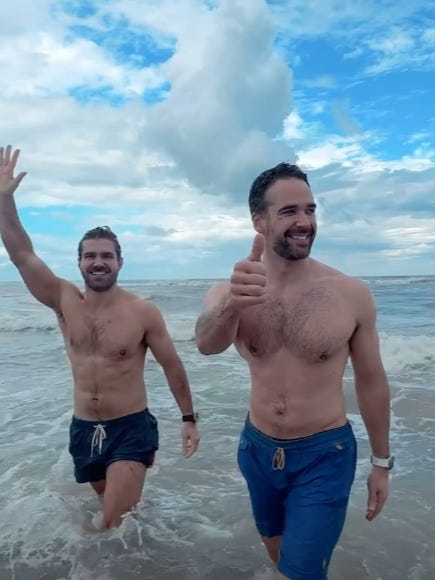
 Tiktok failed to load.
Enable 3rd party cookies or use another browser
Leite, who’s currently 41 years old, came out as gay in July 2021 during an interview on TV Globo’s Conversa Com Bial.
“I’ve never spoken about a subject that…has to do with my private life, and which wasn’t a subject until now,” Leite explained, suggesting that he was being pressured to disclose his sexuality. “I’m gay. But I’m a governor who is gay, not a gay governor. Like Obama, in the United States, who wasn’t a Black president, but a president who is Black. And I’m proud of that.”
As the governor of a prominent Brazilian state, Leite automatically became the highest-ranking gay politician of the country and a household name in Brazil. On the other hand, Leite’s right-leaning politics caused an immediate clash between him and the LGBTQ+ community. A cultural shock also came into play, as it’s always been — and still is — uncommon for an out gay politician in Brazil to be aligned with a conservative party.
Leite and Bolzan’s relationship was revealed shortly after the governor came out as gay. Bolzan, a doctor who’s currently 33 years old, reportedly balanced out his own professional schedule with the various political events he was expected to attend alongside Leite, many of which got media coverage for the novelty of this dynamic among all other elected governors in history.

But even as Leite and Bolzan became a powerful couple in Brazilian politics and pop culture, they were continuously challenged by the LGBTQ+ community for his conservative affiliations. Namely, while Leite didn’t share many of the far-right views of then-president Jair Bolsonaro, he still supported Bolsonaro’s 2018 presidential campaign (which Bolsonaro won), as well as his reelection bid in 2022 (which Bolsonaro lost).
Bolsonaro, whose far-right views include many homophobic remarks, held a press conference one day after Leite came out on TV to mock the governor and accuse him of having ulterior motives for disclosing his sexuality.
“That guy, yesterday… He thinks he’s, like, the greatest, right?” Bolsonaro told a group of journalists. “He beat his chest, like, ‘Look, I came out!’ It’s a calling card for his candidacy [for president].”
Bolsonaro added, “Nobody has anything against anyone’s private life. But wanting to impose your customs, and your behaviors, on others… No.”
Over the years, Leite was heavily criticized for mishandling the impacts of natural disasters in the state of Rio Grande do Sul. He was also accused of spending exorbitant amounts of money seemingly invested on his own career, positioning himself as a national political figure who could potentially run for president as a worthy candidate. And yet, when the 2022 Brazilian presidential elections came around, Leite wasn’t even close to the starting line.
Leite eventually read the room and shifted his efforts to run a 2022 reelection campaign for governor of Rio Grande do Sul. But given how much time and money he had spent on trying to come across as a presidential hopeful, Leite’s state electorate wasn’t exactly thrilled about his prospects for reelection. This resulted in a messy and bumpy campaign in which Leite found himself deeply stuck in second place on the polls. At least until he found himself in a runoff with political opponent Onyx Lorenzoni.
What changed, you ask? Well, Lorenzoni flippantly said during a radio interview that the state needed to elect him in order to have “a real first lady” again. Yes, you read that right: This candidate earnestly referenced the fact he has a wife (so he’s straight!) as a good enough reason to gain people’s vote against Leite (because he’s gay!).
Lorenzoni’s insane remark went viral and brutally backfired. Leite was reelected.
Leite disclosed on his second term that he and Bolzan had quietly formalized their relationship as a civil union in 2023. Given the remarks spewed by his opponent during the campaign, Leite rewrote the protocol of the governor’s official residence to allow himself to seat and announce his partner as his husband, officially.
 Tiktok failed to load.
Enable 3rd party cookies or use another browser
In the subtly snarky (but hilariously shady) video above, Leite is seen acting as a guide of the governor’s residence, Palácio Piratini, to a group of women from the Miss Brasil pageant system. There he is, an out gay and reelected governor, at his official residence, surrounded by beautiful women — most of whom with the poise and elegance of a “first lady” — except that he’s definitely still gay and lives there with his husband instead.
Conservatives have an awful track record with social media content, so I guess it takes a Brazilian gay conservative to do something that feels at least kind of witty and amusing in response to a rival politician’s homophobic remarks.
Leite also shared earnest posts referencing that campaign scandal. For instance, he wrote the following statement on Instagram:
“I’m gay, I’m married, I’m governor. My fight is not to impose anything on anyone, but so that no one has to hide who they are in order to be respected. Today is International Day against Homophobia, Transphobia, and Biphobia, but this commitment is valid all year long. May love and respect always guide our choices.”

Reports surrounding Leite and Bolzan’s very public and politicized relationship tell a fascinating story about queer media. A tale about the most famous out gay politician in a massive democratic country like Brazil being a conservative, and a supporter of Bolsonaro’s two presidential runs, despite repeated homophobic remarks from the then-president and even direct attacks against Leite’s personal coming-out journey. A story about a governor who failed his state in the pursuit of a dreamy presidential run (unrelated to his sexuality), but who did so knowing that his odds of becoming president were much lower than the average hopeful (due to his sexuality). A saga with an unbelievable plot twist in the form of an outrageously homophobic statement from a political rival, boosting Leite from trailing behind in the polls to being triumphantly reelected as public sentiment suddenly — and briefly — turned in his favor.
Leite’s second term as governor ends in 2026 (besides a transitional period that takes place in January 2027). He’s already been reelected as governor and can’t run again. He is also very far from reaching any momentum to run a successful presidential campaign in Brazil later this year. And, as of this week, the public is also aware that his relationship with Bolzan has officially ended. A relationship that, in many ways, defined and aided Leite’s political rise; and, in other ways, was also irrelevant to Leite’s actual, practical challenges of governing a state.
There’s a growing number of politicians within the LGBTQ+ community who are occupying high-ranking positions of power around the world. For gay men like Leite, that includes names such as Rob Jetten, elected Prime Minister of the Netherlands, and Pete Buttigieg, former U.S. Secretary of Transportation who’s eyeing a presidential run in the near future.
Between the lessons worth learning, warnings worth noting, and idiosyncrasies bound to get lost in translation, Leite’s political saga is a chaotic but intriguing illustration of how “queer representation” has been redefined in the 2020s, particularly when compared to the more innocent connotations of the term in the 2010s. For one, simply being a member of the LGBTQ+ community is absolutely not enough. This is also an era marked by queer conservatives making themselves known yet again, reminding the community that they’ve always been here (and will continue to be). Reflecting on Leite’s history, there is also something curious about how quickly and fiercely public perception can change in reaction to a circumstance that seems unnecessarily cruel, humiliating, and/or violent, no matter how negatively perceived the victim was prior to that circumstance.
Share your thoughts!
Do you think the U.S. is ready to elect an out queer president in the near future?
If you live elsewhere: How would you describe the public sentiment toward out queer politicians in your country?